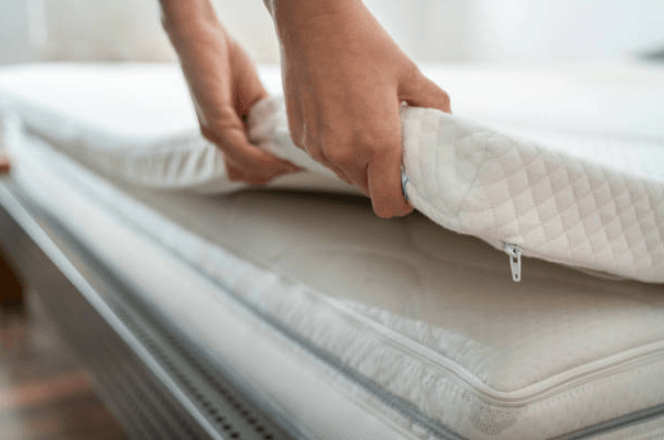

Not everyone needs a latex mattress topper. That might sound like an odd way to open a piece about one, but it is true. Some people will buy one and wonder why they waited so long. Others will find it too firm, too springy, or simply not what they expected. The difference usually comes down to one thing: knowing whether your sleep problems are the kind that latex actually solves. So let’s get into it. Who is this latex mattress topper really made for?
Latex Mattress Topper Benefits for People Who Sleep Hot
If you wake up sweaty or find yourself flipping the pillow to the cool side every hour, your mattress surface is likely trapping heat. Memory foam is the usual culprit. It contours well, but it does so by absorbing body heat, and that warmth has nowhere to go. Latex mattress toppers behave differently. It has an open-cell structure, and natural latex toppers often come with pin-core holes running through them. Air moves through the material rather than getting locked inside.
The Sleep Foundation notes that latex sleeps considerably cooler than foam alternatives, which is perhaps the most practical reason Indian sleepers in warmer climates reach for it.
If heat is your main complaint at night, a latex topper deserves a serious look.
See also: Social Media Technology Trends
Back Sleepers Who Need Latex Mattress Topper Support
Back sleepers have a specific problem. They need a surface that supports the lower back without letting the hips sink too far in. Too much softness creates a hammock effect, where the hips dip below the shoulders, and the lumbar curve deepens through the night. You wake up stiff, sometimes with a dull ache that takes an hour to work itself out.
Latex pushes back. It has what material scientists call resilience, meaning it returns to its original shape quickly rather than holding a compressed form. This gives back sleepers a firm, even surface that keeps the spine level without feeling like they are lying on the floor.
A medium-firm natural latex topper, typically around 5 to 7.5 cm thick, suits most back sleepers well. That said, heavier sleepers may need to go slightly thicker to get the same effect.
When a Latex Mattress Topper Works for Joint Pain
This is where it gets a bit more layered. Latex does not cushion joints the way memory foam does. It does not cradle the shoulder or hip the same way. So if you are a side sleeper with significant joint sensitivity, a very firm latex topper might actually make things worse.
Where latex does help with joint discomfort is in pressure distribution across the whole body. Because it is responsive and does not create deep sink points, your weight spreads more evenly across the surface. Research published in the Journal of Chiropractic Medicine found that medium-firm sleeping surfaces reduced lower back pain and improved sleep quality in participants over a 28-day period. Latex, by nature, sits in that medium-firm range.
So perhaps the honest answer is this: latex helps with general body aches and postural discomfort better than it helps with localised joint pain.
People Dealing With Allergies and Latex Mattress Topper Options
Here is something worth knowing. Natural latex comes from rubber tree sap, and most of it goes through extensive washing during manufacturing. The Dunlop and Talalay processes both reduce the protein content that triggers latex allergies. The American College of Allergy, Asthma and Immunology notes that processed latex products carry a lower allergy risk than raw latex exposure.
Beyond that, natural latex resists dust mites and mould naturally. For people who sneeze in the morning, wake up with a stuffy nose, or react to synthetic bedding materials, switching to a natural latex topper can be a meaningful change. It is not a medical solution, but it removes one common allergen source from your sleeping environment.
Latex Mattress Topper Suitability for Heavier Sleepers
Standard foam toppers compress under heavier body weight and lose their shape over time. Latex holds up better. Its density and resilience mean it does not develop body impressions the way softer materials do. A good quality natural latex topper can last eight to ten years with regular care, which is longer than most foam alternatives.
For sleepers above 90 kg, a denser latex topper, around 65 to 80 kg per cubic metre, will maintain its support rather than bottoming out after a year of use.
Finding Out if it is Right for You
The clearest sign that a latex mattress topper might work for you: you sleep hot, you prefer a firmer surface, or your current mattress feels too hard on top but still has life left in it. If two or three of those apply, it is worth trying.
Start with the thickness and density that match your weight and sleep position. Give it a few weeks before you judge it. Sleep habits take time to adjust, and so does your body.

 By
By